Recent childcare reports raise serious concerns about Washington state’s handling of funding, with the state auditor questioning millions of dollars in payments tied to federal support.
While the findings may not point to widespread fraud, they do reveal something equally troubling: gaps in oversight, weak verification processes and a system that is not consistently tracking where taxpayer dollars are going.
That should concern every Washington family, because this is not just about numbers on a spreadsheet; it is about whether we are delivering on a promise to children and working parents across our state.
At its core, childcare is not optional for many; it is essential infrastructure for families and our economy. Quality childcare creates safe, structured environments where children can learn and grow, while also allowing parents to work, pursue careers and provide for their families.
Washington families are already feeling the pressure of a high cost of living, which is significantly above the national average.
Housing, transportation, and everyday expenses cost more here than in most parts of the country, putting added strain on working families trying to make ends meet. When childcare costs are layered on top of that reality, it becomes even harder for parents to stay in the workforce and provide for their children.
That is why it is so important that every dollar dedicated to childcare is spent wisely and reaches the families and providers who need it most.
In many parts of Washington, including Southwest Washington, families are struggling with limited access and rising costs. Entire communities remain “childcare deserts,” where options are scarce or nonexistent. When funding systems lack accountability or fail to deliver resources effectively, those gaps widen, leaving working families behind.
That reality underscores why accountability must be the foundation of any successful childcare system. The auditor’s findings suggest that, in some cases, the state has made payments before fully verifying attendance or documentation, relying on corrections after the fact rather than on strong front-end safeguards. This approach undermines confidence and risks misallocating resources that should support children and families. Accountability is not about blaming providers or creating unnecessary hurdles; it is about ensuring that public dollars are used as intended and that the system performs for those who depend on it.
At the same time, we must recognize that childcare providers are essential partners in this effort. They are small business owners, educators, and caregivers who are already navigating tight margins and workforce challenges. A system that lacks clarity or consistency can make their jobs even harder. That is why improving accountability must go hand in hand with supporting providers through clear expectations, efficient processes, and timely, accurate payments. When the system works as it should, providers can focus on delivering high-quality care instead of navigating bureaucratic uncertainty.
Ultimately, the stakes are much higher than administrative fixes. Quality childcare is one of the most effective ways to break the cycle of intergenerational poverty. Children who have access to early learning opportunities are more likely to succeed in school and in life. At the same time, parents with reliable childcare are better able to maintain stable employment and improve their financial future. This is not just a social issue; it is an economic one that affects the long-term health of our communities.
That is why Washington must get this right.
We have made significant investments in childcare, but investment alone is not enough. We must ensure those dollars reach the right places, serve the right families, and produce real results. Working families and children are depending on the state to eliminate childcare deserts and expand access to quality care. That cannot happen if we cannot account for the payments or ensure they are going where they are needed most.
This year, House Republicans offered solutions to help shine light on issues of accountability and transparency. Those solutions included Rep. Josh Penner’s HB 2280, which would provide greater access for legislators to DCYF facilities, and Rep. Travis Couture’s HB 2058, which would require private entities receiving public money to hire third-party auditors to account for public funds.
In the end, accountability and opportunity go hand in hand. If we build a system that is both responsible and effective, we can strengthen trust, support providers, and deliver meaningful outcomes for families. Washington families deserve a childcare system that works, not just in theory, but in practice, and it is our responsibility to make sure it does.
•••
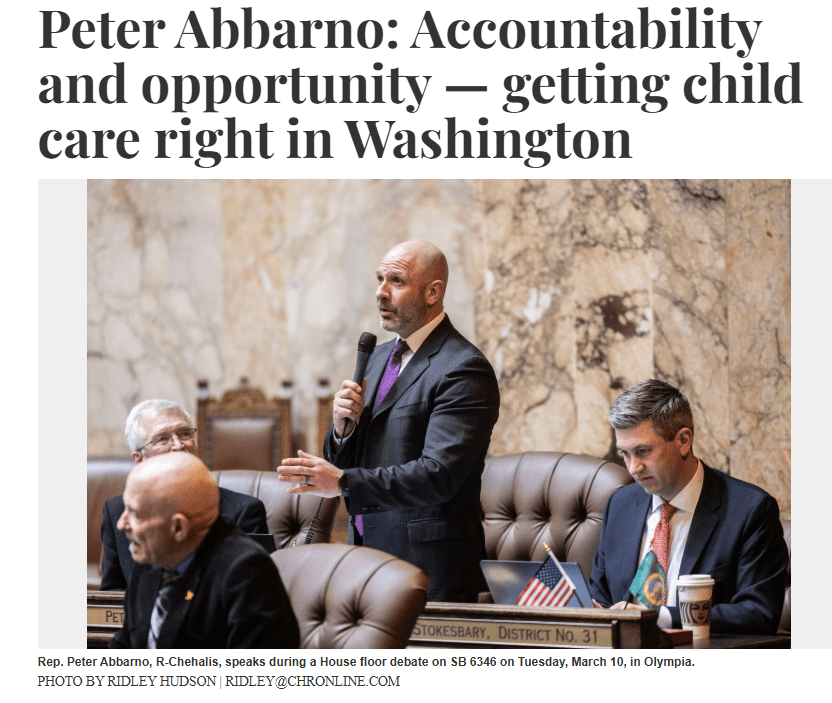
Rep. Peter Abbarno, R-Chehalis, represents the 20th Legislative District and is the House Republican Caucus chair.