In the Centralia-Chehalis Chamber of Commerce by Rep. Peter Abbarno
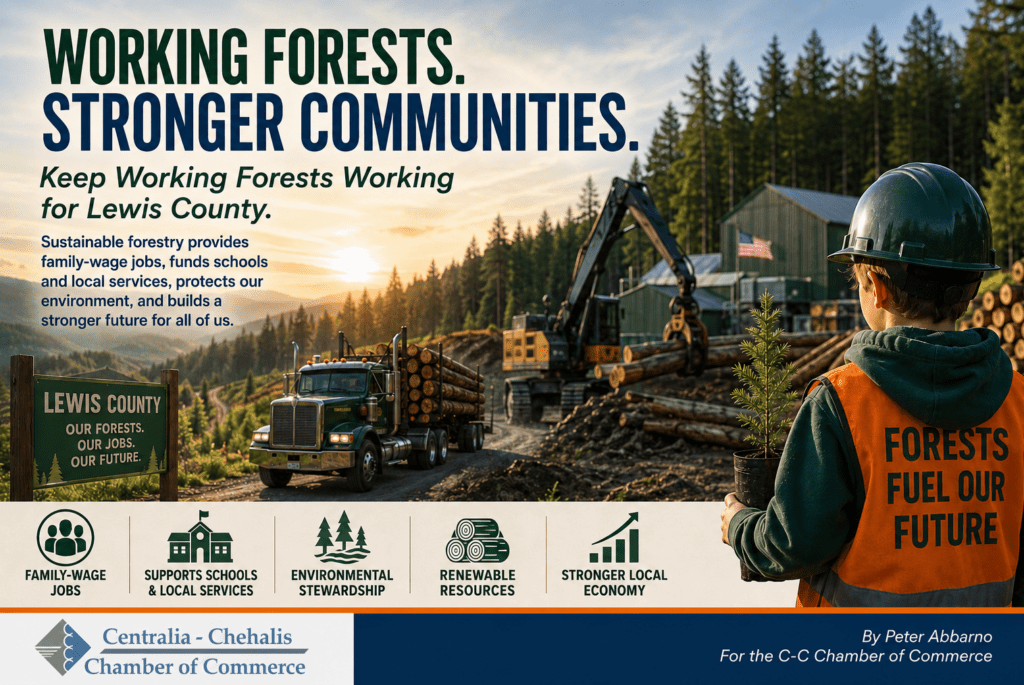
In Lewis County, our forests are more than scenery. They are a cornerstone of our economy, a source of family-wage jobs, a critical funding mechanism for schools and local services, and an important part of responsible environmental stewardship.
For generations, working forests have helped build our communities. They support loggers, truck drivers, mill workers, equipment operators, foresters, and countless small businesses that depend on a healthy timber economy. In rural communities like ours, the timber industry is not simply part of our history, it remains an essential part of our future.
Across Lewis County, the forest products industry supports almost 6,000 jobs with total annual wages exceeding $450 million. In Washington state, the timber industry supports over 102,000 jobs and generates over $6 billion in wages annually. Working forests sustain the state’s third-largest manufacturing industry and contribute more than $300 million annually in taxes and fees that help support public services. These jobs and revenues are especially important in counties like Lewis County, where natural resources continue to play a significant role in the local economy.
That is why I have voiced significant concerns over recent decisions by the Washington State Department of Natural Resources and Commissioner of Public Lands Dave Upthegrove paused timber sales in older forests and later designated approximately 77,000 acres of older state trust forests for conservation-oriented management rather than traditional timber harvests.
Working forests also directly benefit schools and local governments. Timber harvests generate tax revenue that helps fund education, public safety, roads, and other essential services. In many rural communities, timber revenues have long helped support school districts and public institutions that would otherwise struggle to maintain services. When our timber industry succeeds, our communities succeed.
Unfortunately, too often the conversation about forests focuses only on preservation versus production. The reality is much more nuanced. Sustainable forestry demonstrates that environmental stewardship and economic opportunity are not mutually exclusive.
Modern working forests are carefully managed by professional foresters under some of the most comprehensive environmental regulations in the nation. These forests provide renewable building materials while protecting fish habitat, water quality, and wildlife. In Washington, working forests help protect more than 60,000 miles of streams and millions of acres of habitat. For every tree harvested, multiple trees are planted in its place, creating a continuous cycle of growth and renewal.
Washington foresters plant approximately 52 million trees every year, which is three trees for every one harvested. There is also a growing body of evidence showing that actively managed forests can play an important role in addressing climate change. Many people assume older, unmanaged forests provide the greatest climate benefits. However, research increasingly shows that sustainably managed forests often capture carbon more efficiently because younger, growing trees absorb carbon at faster rates.
In addition, harvested wood products continue storing carbon for decades. According to research cited by Washington forestry organizations and the University of Washington, managed forests in Washington grow significantly faster and sequester more carbon per acre than unmanaged federal forests. Washington’s forests and wood products offset a substantial portion of the state’s carbon emissions.
Active forest management also reduces wildfire risks. Washington has experienced devastating wildfires fueled by overcrowded forests, excessive undergrowth, disease, and dead timber. Unmanaged forests often experience higher tree mortality and create greater fuel loads that increase the likelihood of catastrophic fires. Those fires not only threaten communities and wildlife but also release massive amounts of stored carbon back into the atmosphere. Sustainable forestry practices; including thinning, harvesting, reforestation, and fuel reduction, help keep forests healthy and resilient.
This is why I believe we must continue supporting policies that keep working forests working. That means encouraging active forest management, supporting responsible timber harvests, investing in forest health, protecting family-wage forestry jobs, and ensuring regulatory policies are grounded in sound science.
Lewis County has long understood the value of working lands. Our timber industry helped build schools, businesses, and neighborhoods. Today, it continues to provide careers, support local governments, and contribute to a healthier environment.
Working forests are not a relic of the past. They are a renewable resource that benefits our communities today and for generations to come.
Simply put, we must keep working forests working for Lewis County.